My dear book-lover,
I had a frustrating moment a couple of weeks ago. Because I love listening to stories while walking or doing household chores, I often buy audiobooks. This time I had selected The Kingdom of Back by Marie Lu. It’s the story of Mozart’s sister Anna (“Annerl” in Bavarian). It begins in Salzburg, with Annerl’s early memories of her brother Wolfgang’s (“Wolferl”) musical genius. Obviously, all place and people names are in German. Unfortunately, the performer was mostly unable to pronounce these names correctly. “Annerl” and “Wolferl” turned into what sounded like “Anrul” and “Wolfrul”; I — a native German speaker — struggled to understand many of the names because of the mispronunciations.
I eventually had to stop listening, which got me thinking about how the medium shapes our perception of a story. I might have ended up liking the book, but I just couldn’t keep listening to the performer’s pronunciation mistakes. In this case, the medium negatively affected my perception of the story. What bothered me wasn’t only the mispronunciation itself, but the sense of a growing disharmony between the story and me.
Today, I’d like to discuss how the way we experience a story — through reading or through listening — shapes our perception and affects our interpretation of it. For explorations like this, I created the Reading Lens — a space for reflection, curiosity, and deeper engagement with the stories we encounter.
Encountering a Story
Most of us encounter stories either by reading a paper book or eBook, or by listening to an audiobook. Of course, there are practicalities attached to all three:
Paper books are the most tangible of the three, because you can interact with them directly. You can make notes, put in a bookmark, display it on a shelf, give it to a friend. Very similar to this, eBooks are pragmatic alternatives. You can carry all your books with you in one small device.
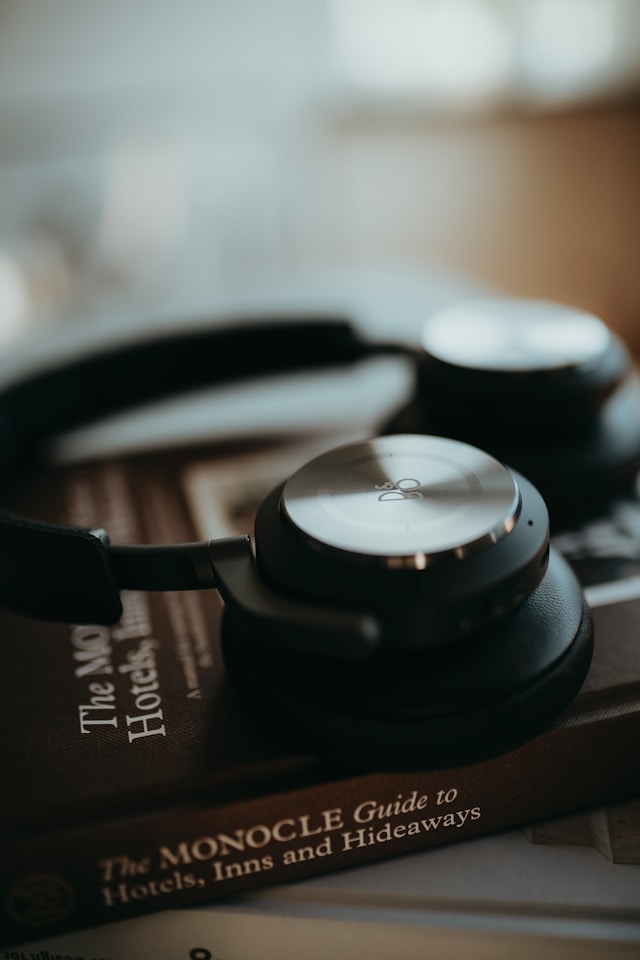
Audiobooks are practical in a different way. You can listen to your book and have your hands free for easy chores, which can make unenjoyable tasks much more fun.
These practical differences are real — but they don’t, on their own, explain how our perception is shaped or what that means for interpretation.
When a Text Takes Shape
Practicalities aside, there are important differences in how we engage with the story when either reading or listening. Please note that I’m only talking about books here that are meant to be read; I’m not including theatre plays, poems or similar works here.
Paper books and eBooks both require us, as readers, to interpret the text for ourselves. When reading, we are directly interacting with the story from the page. We interpret punctuation, pauses, tone of voice, and intonation to shape pace, characters, and dialogue.
For a long time, I thought audiobooks already covered this task for us, because we don’t have to think about tone of voice or intonation — especially in dialogue. When something is read to us and we do not interact with the text on the page ourselves, what we hear is how the performer interprets pace, voice, intonation. We primarily hear the performer’s interpretation of the text. Subtle ironies you might have picked up may be lost to them. Maybe the text is more quiet or more angry in their interpretation than it would be in your own.
As a reader, the interpretation of the text and the story is entirely your responsibility. As a listener, you interpret the performer’s version of the text, but still interpret the story, the characters, the text coherence — you interpret what remains once tempo and tone have already been decided. The space for your own interpretation is narrowed by what the performer gives you.
A Layer between us and the Text
In the end, the central question is how much of the interpretation we want to allow someone else to do for us. When we read a book, there is no additional layer between us and the narrator. When we listen to an audiobook, we allow the performer to sit between the narrator and us. And their interpretation of the text can affect ours. This may rob us of certain possible interpretations — but it may also enrich our experience, because they make the text come alive.
Personally, I love interacting with the text directly — to be as close as possible to the source of the narration. But I’m also a pragmatist, and I enjoy listening to a great performer tell me a story. For me, every text opens its own interpretive space, and by choosing the medium we get to occupy this space in different ways.
The Text through Your Lens
When did a medium change a story for you? When did someone else’s voice sharpen — or quietly narrow — your experience of it? And when did you choose that trade-off deliberately?
Before I leave you with these questions, feel free to visit my Contribee page, if you’d like to help keep the Lens sharp. Think of it as dropping a coin into the storyteller’s hat — no pressure, just a small gesture of appreciation.
And if you know someone who loves to think about the fabric of stories and how we interact with them, feel free to pass this Reading Lens article along. There’s always room for a fellow thinker.
Hope to read you soon,
Kalypso