My dear reader,
in the last newsletter we travelled to a remote lighthouse off the coast of Australia to ponder what we are allowed to do on account of our own happiness. I believe this is a question we can never answer with absolute certainty; sometimes all our guiding lights fail, and we must make a choice even when every option feels wrong.
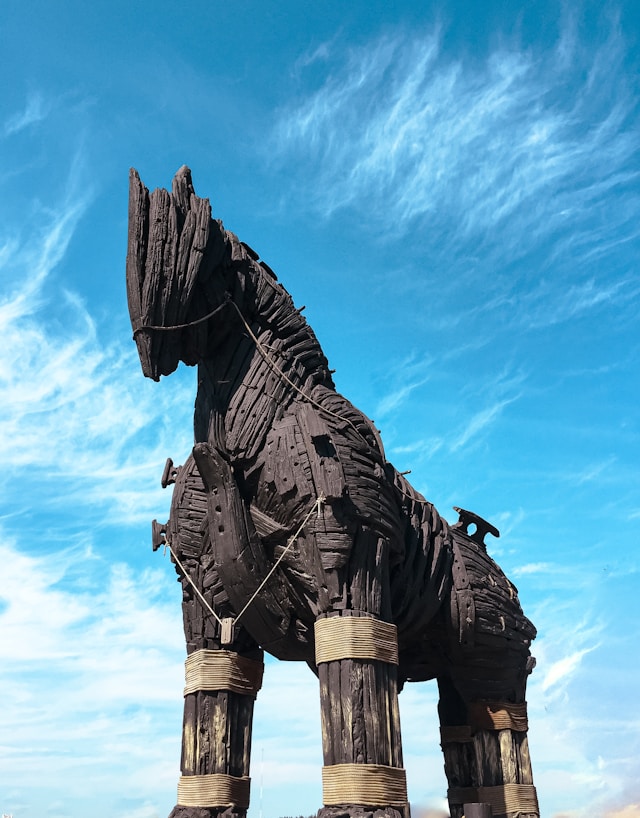
This month, our journey is less about distance and more about time — we’re visiting an era long past, scarcely recorded in history. We’re traveling to ancient Greece — or more specifically, ancient Troy at the time of the Trojan War. The events of the story are well-known and have been passed down through the millennia. Though the events themselves belong to a distant past, the underlying human experiences remain unchanged today.
A Tale as Old as Time
In Pat Barker’s novel The Silence of the Girls the story of the Trojan War is told from the point of view of Briseis, the princess of Lyrnessus. The story begins with the sacking of the city in which her brothers and husband die by Achilles’ sword.
Long after the Trojan War is over, Briseis describes how she and the other women were taken by force and enslaved. She is given to Achilles as a war prize and made his slave. As Briseis is the main narrator of the story, some of the events that are usually covered in retellings of Homer’s Iliad are left out or only appear on the margins. Instead, the narrative centers on her own experiences, bringing the events that matter most to her into sharp relief.
We get a glimpse of what is going on inside the Greek camp — the suffering of those enslaved, the relationships they build amongst themselves and with their captors — as well as an unusual, perhaps more private picture of Achilles. While The Silence of the Girls questions the Homeric ideal of Achilles as the great hero, it never reduces him to a soulless brute. Briseis’ view of Achilles is more layered and complex — he is both these things and none of them. He’s carrying his very own burden and emotions — he’s human like all of us.
A Tale Retold
Telling the events from Briseis’ point of view gives us the opportunity to challenge the traditional version of the story; the first person as narrator brings us even closer to Briseis’ view of the events. She brings in her opinion and interpretation to these events which gives them a unique perspective.
At the same time, the narrator is neither omniscient nor objective, but highly limited and subjective. Barker mitigates some of the narrowness of the first person narrator by — very purposefully — having some chapters taken over by a third person narrator focused on Patroculus or Achilles.
Allowing a second narrator’s perspective does more than relieve the limitations of Briseis’ perspective, it also challenges it: Is Briseis a reliable narrator? Is she telling us everything? Is she maybe carefully selecting what she wants us to know? Could she even hide something from us?
For me, the suspicion that Briseis is not always reliable became very strong when she tried to explain why — after she had nearly successfully escaped from the Greek camp — she returned to Achilles’ compound. She rationalizes it later, but the reasoning feels thin. It left me wondering whether her feelings towards Achilles had changed in the course of the story.
What History Remembers
It is often said that history is written by the winners — from the perspective of those who dominated in the end. We’ve seen this in other stories too — in Lisa See’s Snow Flower and the Secret Fan, Yaa Gyasi’s Homegoing, and also James Welch’s Fools Crow.
In Pat Barker’s The Silence of the Girls the question of how history is told and whose perspective lives through time was especially loud for me. Briseis’ point of view challenges our traditional reading of the Trojan War and of the great hero Achilles — but not by rewriting them, but by adding layers and facets rarely seen before. Recently, authors like Pat Barker or Yaa Gyasi have started to challenge traditional history book accounts. They do not dispute the events themselves, but the lens through which we have come to understand them. The absence of these perspectives may not even be intentional; they might simply have been irrelevant to those recording the version of history we as a society have accepted as fact.
What stories have challenged your previous understanding of history? How and why did they change what you’ve considered to be the truth? What did you previously accept as “how things were” simply because no other voice was present? I’d love to hear from you. Just reach out via mail or owl.
If you’d like to help keep the lantern lit on this journey through time and story, feel free to visit my Contribee page. Think of it as dropping a coin in the storyteller’s hat — no pressure, just a small gesture of appreciation.
And if you know someone who loves to get lost in good stories and explore the world through books, feel free to pass this newsletter along. There’s always room for a fellow traveler.
See you at the next campfire,
Kalypso